
The Central Bank of Nigeria’s September decision lowered the Monetary Policy Rate by 350 basis points, from 26.5% to 23%. The size of that move invites a familiar reading: borrowing should become substantially cheaper and fixed-income yields should fall by a similar amount. The CBN’s own explanation calls for a more careful interpretation.
At its meeting on 21–22 September 2026, the Monetary Policy Committee also changed the standing-facilities corridor to 50 basis points above and 300 basis points below the MPR. It retained cash reserve requirements of 45% for deposit money banks, 16% for merchant banks and 75% for non-Treasury Single Account public-sector deposits. These are the decisions recorded on the CBN’s policy-decision page.
In its communiqué, reproduced by Proshare, the CBN described an operational realignment intended to restore the MPR’s usefulness as a policy signal. It said the divergence between that benchmark and prevailing market rates had weakened transmission, and explicitly cautioned against interpreting the recalibration itself as a change in the underlying policy stance.
The corridor explains part of the change
The July settings were an MPR of 26.5% with a corridor of plus 50 and minus 450 basis points. Simple arithmetic put the upper and lower rates at 27% and 22%. September’s new settings imply 23.5% and 20%, respectively. The lending side therefore fell by 350 basis points, while the deposit side fell by 200.
Those are meaningful changes in the operating framework. But a policy rate’s influence depends on where financial institutions actually transact, how much liquidity they have and whether central-bank facilities are the relevant marginal alternative. A large change to a benchmark that had become disconnected from trading conditions cannot be read in the same way as an equally large shift in a benchmark already steering the market closely.
The practical test is whether the new arrangement creates a more reliable connection between the CBN’s stated intentions and the price of short-term money. That requires observing transactions after the decision, rather than simply subtracting 3.5 percentage points from every rate in an investment spreadsheet.
Watch the transaction benchmark
The Nigerian Overnight Financing Rate, or NOFR, is designed to reflect secured overnight naira funding among eligible financial institutions. The CBN describes it as transaction-based. It offers a useful reference for assessing whether actual money-market conditions are moving with the recalibrated framework.
Even then, overnight funding is only one part of the transmission chain. Treasury-bill auctions reflect available liquidity, demand and the issuer’s funding choices. Longer-dated bonds also embed expectations about inflation, future interest rates and the compensation investors require for tying up money. Bank loans add credit risk, operating costs, capital considerations and borrower-specific terms.
A lower overnight rate can support easier financing conditions without producing an immediate, uniform reduction in every loan price. Equally, persistent tightness in market funding would weaken the argument that the headline reset had already delivered broad relief.
Banks and savers face different repricing clocks
For banks, the earnings effect depends on both sides of the balance sheet. The return on newly purchased securities may change quickly, while existing fixed-rate assets retain their contractual cash flows. Deposit costs can reprice on another timetable. Floating-rate loans will depend on their reference rates and reset clauses.
A conclusion that lower rates automatically lift bank profits, or automatically squeeze them, therefore skips the central question: how fast do asset yields move relative to funding costs? Loan demand and future credit losses matter as well.
Savers should make the same distinction between existing holdings and new money. A fixed coupon does not change with an MPC announcement. The market value of the bond can change, and the yield available when cash is reinvested can change too. Deposit and money-market-fund returns have their own adjustment lags.
As the fourth quarter begins, the evidence to watch is concrete: overnight funding transactions, auction outcomes, actual lending quotations and inflation releases. The September reset gives investors a new operating framework to evaluate. It does not, by itself, establish how much financial conditions have eased for a household, a business or a portfolio.
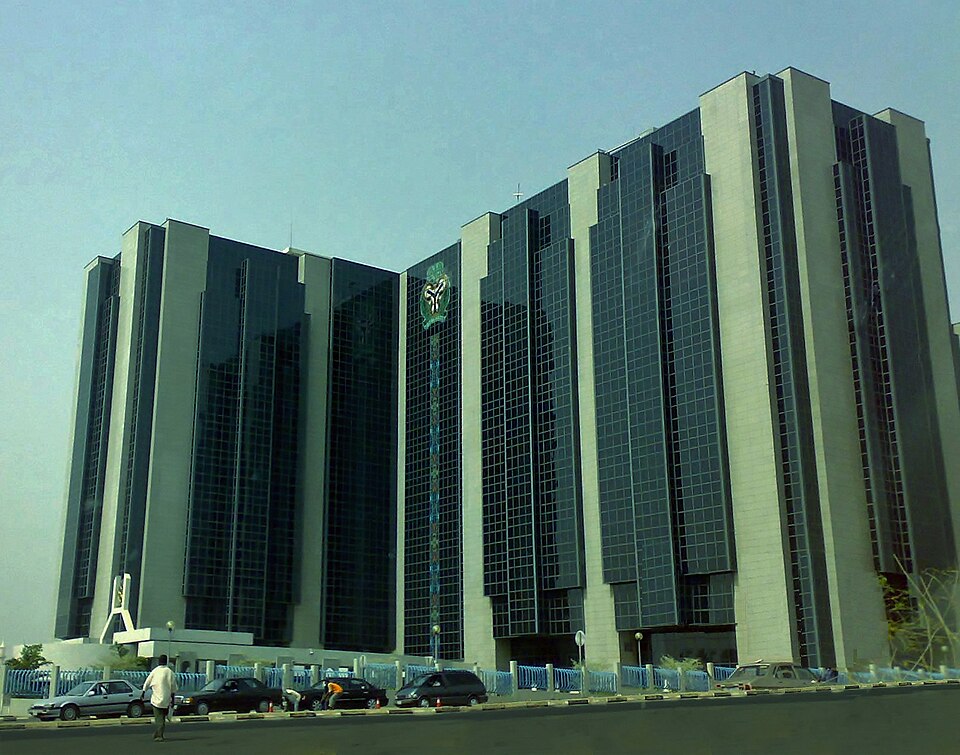
Image: Central Bank of Nigeria headquarters, Abuja. Archive photograph by chippla at English Wikipedia / Wikimedia Commons, released to the public domain. Commons version includes colour correction by Jamie Tubers. Wikimedia-provided 960px rendering; no local visual edits.

